
Bridging the gap for families in crisis
We believe that no child should be defined by their trauma or mental health, and no parent should be bankrupt by their devotion. We provide guidance, advocacy, and financial grants to families navigating the complex intersection of trauma, behavioral health crises, and the legal system.
Small gifts. Massive impact.
Bridging the gap for Florida's "Missing Middle" families.
$15,000+
The Crisis
The average out-of-pocket cost a "Missing Middle" family faces during a single behavioral health crisis episode.
The result: financial ruin and a child sent home to an unsafe environment.
$500
The Waymark
The cost of a Waymark Grant that provides the targeted legal advocacy needed to stop an unsafe discharge.
The result: a child secured in a safe clinical setting and a family empowered to fight.
The story behind the mission
The Waymark Foundation of Florida was born from a mother's fight. It didn't start in a boardroom; it started in the quiet, terrifying moments following a behavioral crisis, the kind that ends with blue lights in the driveway and a child who feels like a stranger.
We quickly learned that for families in the middle of a relentless cycle of defiance and out-of-control behavior, the world feels very small. We experienced the exhaustion of the "missing middle": the space where a child is too high-risk to stay safely at home, but doesn't "qualify" for a hospital bed or a long-term facility.
The Waymark Foundation was created to be the marker in the wilderness for families who are currently where we were: exhausted, financially drained, and told there is nowhere left to go.
We provide grants and navigation tools because we've been in that dark room. We've felt that panic. And we believe that every parent deserves the resources to say: "I am here, and I am not giving up."
Read a Message from Our FounderOur "Waymarks": how we clear the path
Every family deserves to be seen, heard, and supported, not judged.
Navigation & Advocacy
Immediate, tactical guidance for the 24 to 48 hours after a behavioral crisis: crisis maps, advocacy checklists, and documentation guides that doctors and judges can't ignore.
Explore Pillar One →The Grant Program
Financial grants that bridge the gap insurance leaves behind: evaluations, travel to see your child, residential bridge funding, and legal advocacy.
Explore Pillar Two →The "Safe Harbor" Community
Peer support from parents who have lived through the hardest nights, plus trusted national resources so you never have to figure it out alone.
Explore Pillar Three →How you can help
Every family we reach is a family that doesn't have to face the system alone.
Donate
100% of public donations go directly into our Family Grant Fund. No overhead. No bureaucracy. Straight to the families who need it most.
Give TodayPartner with us
We are looking for trauma-informed therapists and family law attorneys willing to offer pro-bono consultations to families in crisis. Your expertise changes lives.
Reach OutShare our story
Help us find the families who are currently where we were, scared, exhausted, and looking for a way forward. A single share can be a lifeline.
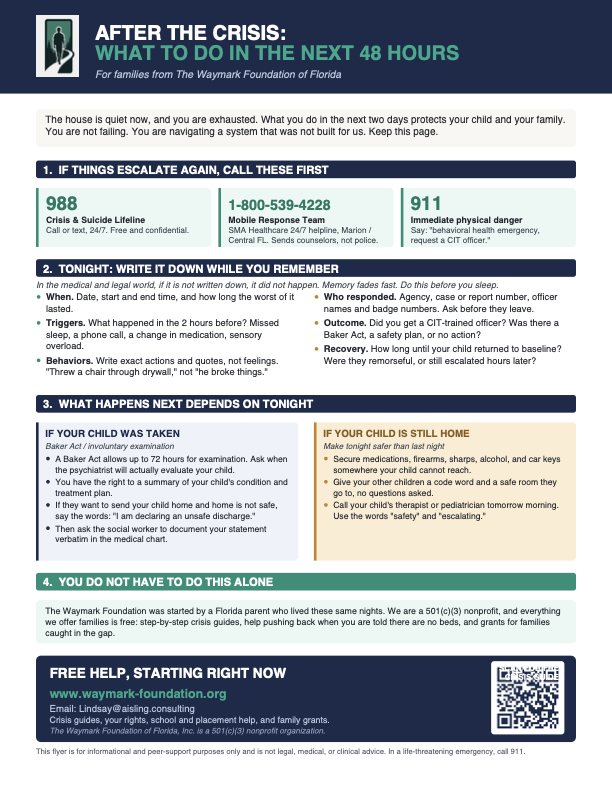
Our StoryThe Crisis Flyer
One page for the hardest night: the numbers to call, what to write down before you sleep, and what to do whether your child was taken or is still at home. Free for families, officers, school staff, and clinicians to print and hand out. No permission needed.
Thank you to the businesses walking with us
We are grateful to the organizations whose generosity helps families in crisis find their way forward.